
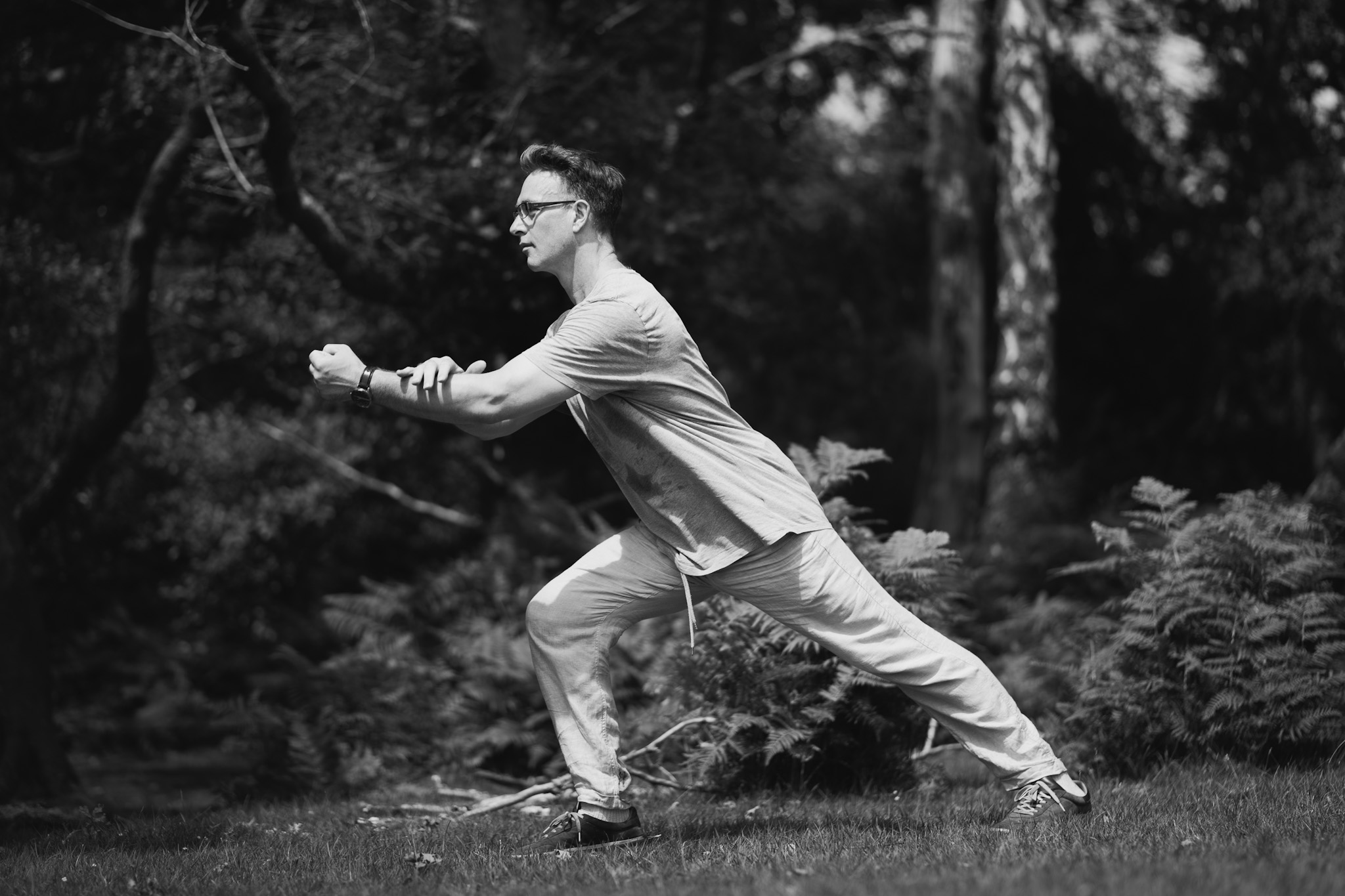
Movement and Awareness / The Hand Form
Same pattern again — heavy academic scaffolding, repeated section-header devices (“Strategic Takeaway” style structure, bolded sub-lists), untranslated terms, Latin phrases. Reworked into your site’s voice:
FOUNDATIONS | TAI CHI
Movement and Awareness / The Hand Form
In our Wutan/Wudang tradition — the combat-focused branch of Tai Chi — the Hand Form is the foundation everything else is built on. Pushing Hands, self-defence, internal strength, weapons work: all of it traces back here.
This isn’t a sequence of moves to memorise. It’s a discipline of thought leading action — the mind directing the body, not the other way round. Chang San Feng, the Taoist credited with founding the art, built it around one idea: maximum effect, minimum effort. The Hand Form is where you learn that, for your health and for real fighting ability. On its own, though, it’s not enough — you need the other four pillars too.
Two stages, like learning to write
You start with the Square Form — simple, deliberate, step by step. Think of it as learning to print block letters: rigid, structured, correct. Only once that’s internalised do you move to the Round Form, where movement becomes fluid and continuous — like cursive. You’re no longer executing steps. You’re writing something. That shift is what turns a health exercise into something with real martial depth.
What it does for your body
Slow, deliberate movement puts a gentle, rhythmic pressure on your veins that actually helps blood return to the heart — genuinely useful for circulation and a safeguard against clotting. The breathing method we use (breathing down into the belly rather than out through the chest) increases oxygen intake and gently massages the internal organs as the diaphragm rises and falls — traditionally used to help digestion. All of it adds up to a body that runs more efficiently, right down to how it processes nutrients and manages inflammation.
What it does for your head
If you spend your week buried in noise and deadlines, the Hand Form is a genuine antidote — no equipment, barely any space needed, just you and fifteen minutes. Regular practice sharpens focus and decision-making, and the slow, soft nature of the movement tends to carry over into how you handle stress generally — people who train this way tend to run cooler, less reactive, less on edge.
Where the self-defence comes from
Every movement in the slow form has a real application underneath it — this is where San Shou (self-defence) eventually comes from. Training with relaxed muscles keeps your joints moving smoothly, which is what actually makes you fast when it counts. And there’s a deeper principle at work: yielding, not resisting. Bend like bamboo in a storm, absorb the force, then spring back. Rigid things break. Flexible things survive. With enough repetition, this stops being something you think about and becomes something you just do.
The whole point
The Hand Form isn’t casual — it’s an investment. Fifteen minutes a day, ideally under a teacher who can spot what you’re doing wrong and show you the difference between moving your body and directing it with intent. That’s the return: a body and mind that work as one system, not two.
Closing CTA:
Ready to start? [The Tai Chi Hand Form Course →] — £111


