
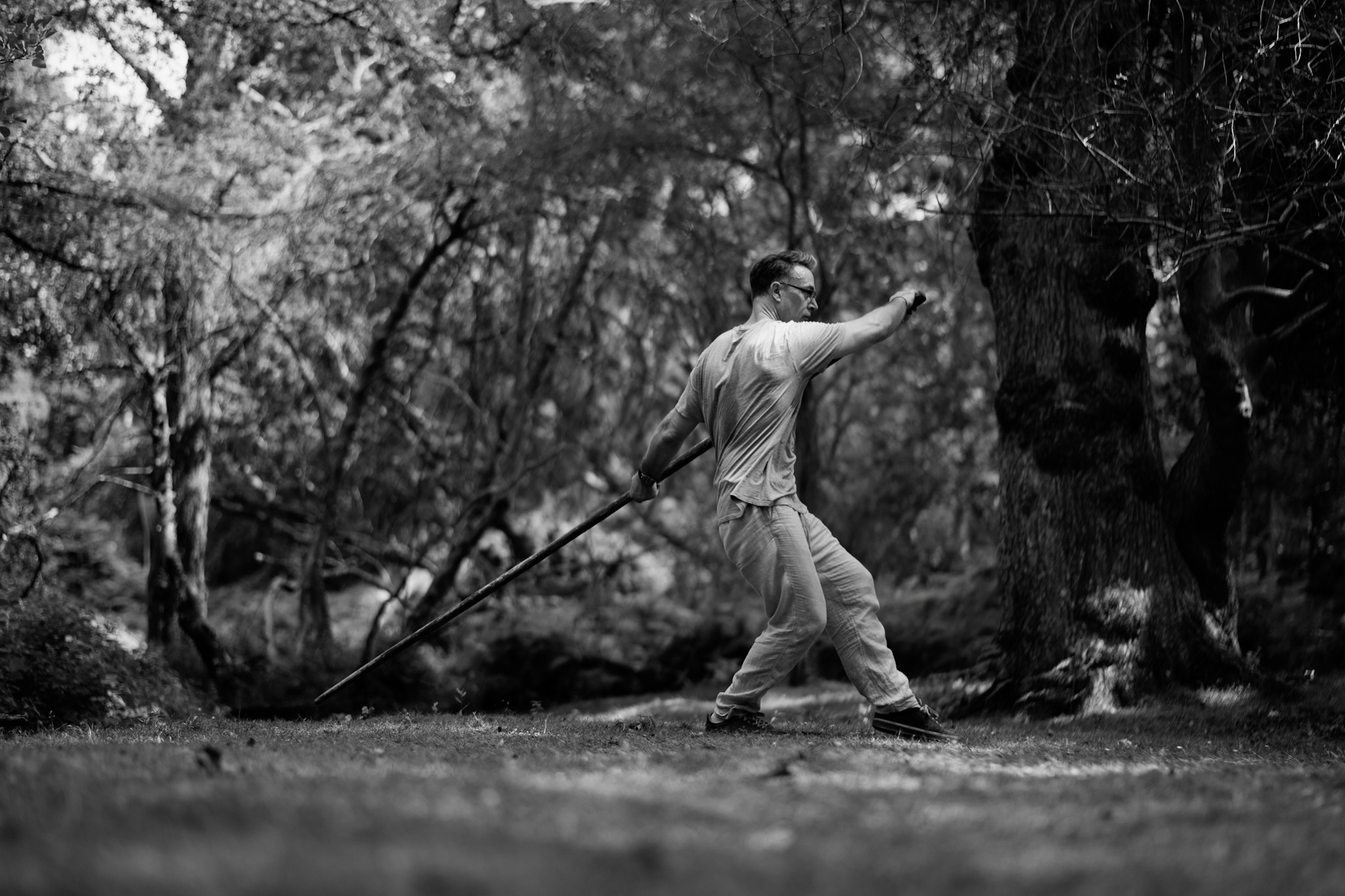
The king of weapons: The spear
Weapon training in Tai Chi Chuan isn’t a side pursuit or a demonstration piece — it’s where the internal power of the solo form gets tested under real conditions. In our lineage, the spear holds the title of “King of Weapons.” It’s the bridge between solo practice and application.
Why the spear specifically
At 7 to 9 feet, the spear forces your whole structure to work together — feet, waist, arms, all moving as one line. There’s no room to fake it. If your internal mechanics aren’t sound, the spear exposes it immediately. Master it, and concepts like leverage and distance stop being theory and become something you actually feel.
Soft beats hard — and here’s why
Swing a rigid stick and a length of rope side by side. The rope’s tip moves faster. That’s the whole principle behind the Tai Chi spear: staying relaxed and elastic generates more speed and more force than tensing up ever could. We don’t block force with force — we stick, we follow, we redirect. Four ounces deflecting a thousand pounds, as the old saying goes: you don’t need to match an opponent’s strength if you can turn it against them.
It’s worked before
In the 12th century, General Yue Fei faced an armored cavalry force that seemed unbeatable — men and horses both covered in iron, chained together in formation. He noticed the one gap: the horses’ legs. His troops used hook-sickle spears from ground level to take out the legs, and the entire “unstoppable” formation collapsed. The lesson holds up today — don’t attack a problem’s strongest point. Find the one exposed weakness that brings the whole thing down.
What it does for your body
Spear work builds a kind of strength solo forms can’t reach on their own — elastic, whip-like power instead of raw tension, driven by rotating through the waist and hips rather than the arms. Combined with proper breathing (expanding down into the belly, not out through the chest), it trains real cardiovascular efficiency too. And unlike raw strength, which tends to decline with age, this kind of trained elasticity tends to get better the longer you practice it.
And for your head
Because contact with an opponent happens at the far end of a long pole, you have to develop real sensitivity — “listening power” — to feel what’s happening at a distance. That kind of trained stillness under pressure doesn’t stay on the training floor. It’s a genuinely useful skill for staying calm when everyday life gets loud.
It’s practical, too
Even a broom handle can become a spear in a pinch — reverse your grip, use the shaft to divert an incoming strike, then counter. The goal of drilling this isn’t memorization. It’s instinct. In a real moment, you won’t have time to think — you’ll just move the way you’ve trained.


