
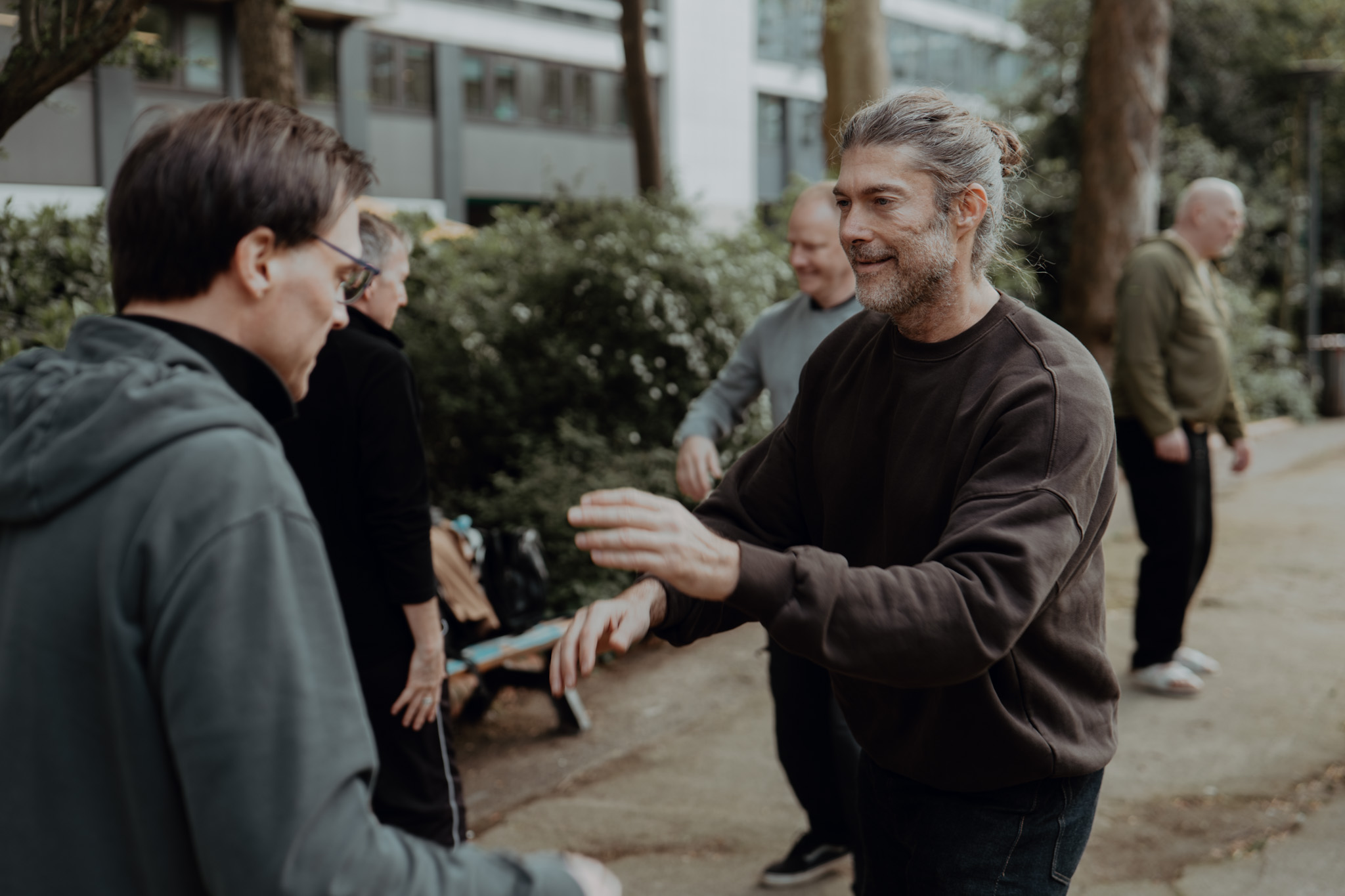
Pushing Hands / Learning to Read, Neutralise, and Control at Close Range
Pushing Hands is the bridge between the solo form and real combat. It’s where philosophy stops being an idea and becomes something your body actually knows how to do — the training ground for the core principle of this whole art: when someone comes in hard, you stay soft.
You learn to feel, not watch
At close range, your eyes are too slow — and too easy to fool with a feint. Pushing Hands trains you out of relying on sight and into reading an opponent through touch instead, which operates faster than conscious reaction ever could. Think of the difference between a rigid stick and a length of rope: the stick’s movement is predictable and limited. The rope can move in ways rigidity never can.
That sensitivity builds in stages — first you learn to feel force coming (“listening”), then to redirect it (“neutralising”), then to release your own force back (“releasing”). You can’t skip ahead. Each stage depends on the one before it. Over time, “sticking” to an opponent and “following” them become the same skill — staying connected without pressure, never losing the thread of what they’re about to do. Eventually the numbness most people have in contact disappears entirely, and you can feel the smallest shift in someone’s balance or tension before they even know it’s happening.
You learn to stay balanced while they don’t
Balance breaks down along specific lines — imagine a diagonal running from someone’s front-left to back-right. Push along that line, where they have no structural support, and you can unbalance them with almost no effort. This is where “four ounces deflects a thousand pounds” stops being a saying and becomes something you can actually do.
Meeting force with force — pushing back against a push — isn’t just bad technique. It slows you down, physically. Two forces colliding restricts blood flow and clouds your thinking in the moment. Pushing Hands trains you out of that instinct entirely, keeping you constantly mobile instead of locked in a contest of strength.
You build the eight core techniques
Every technique in this system — the ward-off, the roll-back, the press, the push, the pluck, the split, the elbow, the shoulder strike — is only as strong as the internal power behind it. Without that foundation, they’re just shapes. With it, they have real snap and depth. Footwork training rounds this out, so these techniques still work even when an opponent is moving and closing distance fast.
You build a different kind of nerve
Training with a partner — someone actively trying to unbalance you — is a controlled way of facing real pressure. It teaches you to override the instinct to tense up and fight force with force, staying relaxed and clear-headed instead, which is what actually lets you move faster than someone who’s gone rigid with adrenaline. History backs the idea that calculated softness beats brute force — smaller, smarter forces have out-manoeuvred much larger ones by finding the gap the larger force couldn’t defend. Pushing Hands is that same principle, practiced on a mat instead of a battlefield.
Closing CTA:
This is where technique becomes real. [Tai Chi Pushing Hands Course →] — £111


