Introduction: The Silent Revolution of Neigong
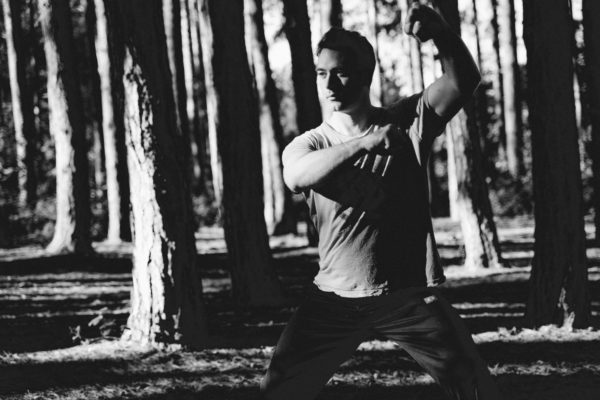
Neigong, or “internal work,” serves as the sophisticated engine driving wudang Tai Chi Chuan, This art is dedicated to the tri-fold goal of self-defense, health preservation, and spiritual cultivation.
As a Scholar-Practitioner, I view Neigong as a departure from the “hard” force of localized muscular contraction. Instead, it is an architectural refinement of the body, prioritizing the development of the sinews (fascia and tendons) and the cultivation of the Biofield.
This “silent revolution” transforms the practitioner from the inside out, moving away from rigid skeletal resistance toward a state of “effortless power.”
The Foundational Principles of Internal Posture
To manifest internal power, the practitioner must move beyond mere choreography and adopt a specific physiological framework.
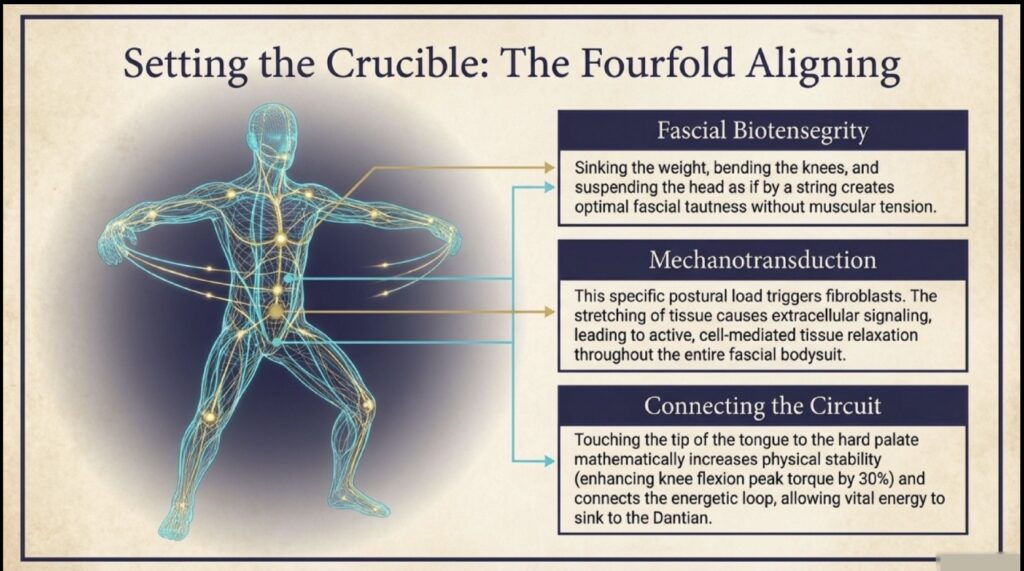
This is governed by the duality of Song (active relaxation/release of antagonistic tension) and Yi(focused intent). By applying Yi, we stimulate mechanotransduction—the process by which cells convert mechanical stimuli into biochemical signals—effectively “tuning” the body’s connective tissue.
The following Universal Alignments are essential for establishing a “Biotensegrity” structure, a term coined by Dr. Stephen Levin to describe the body as a self-tensioned, continuous myofascial network:
- The Suspended Head: The crown (Bai Hui) is aligned as if suspended from above. This reduces cervical lordosis and optimizes the “Spinal Engine Theory” proposed by Gracovetsky, allowing the spine to function as a primary source of power.
- The Plumb Erect Spine: By achieving a posterior pelvic tilt, the practitioner reduces lumbar lordosis. This stretches and engages the thoracolumbar fascia, the body’s central junction for force transfer between the lower and upper limbs.
- The Tiger’s Mouth (Hu Kou): A specific opening between the stretched thumb and forefinger. Crucially, the focus must remain in the hands. As noted by Ian Cameron, over-tensing the shoulders or chest “holds back” the energy; the Hu Kou should create natural tension in the hand while the upper body remains Song.
- The Tongue Position: The tip of the tongue is placed against the hard palate. Scientific pilot studies have demonstrated that this specific alignment facilitates a 30% increase in knee flexion peak torque, grounding ancient “energy circuit” theories in measurable myofascial performance.
Deep Dive: The Three Stages of “The Old Man Making Medicine”
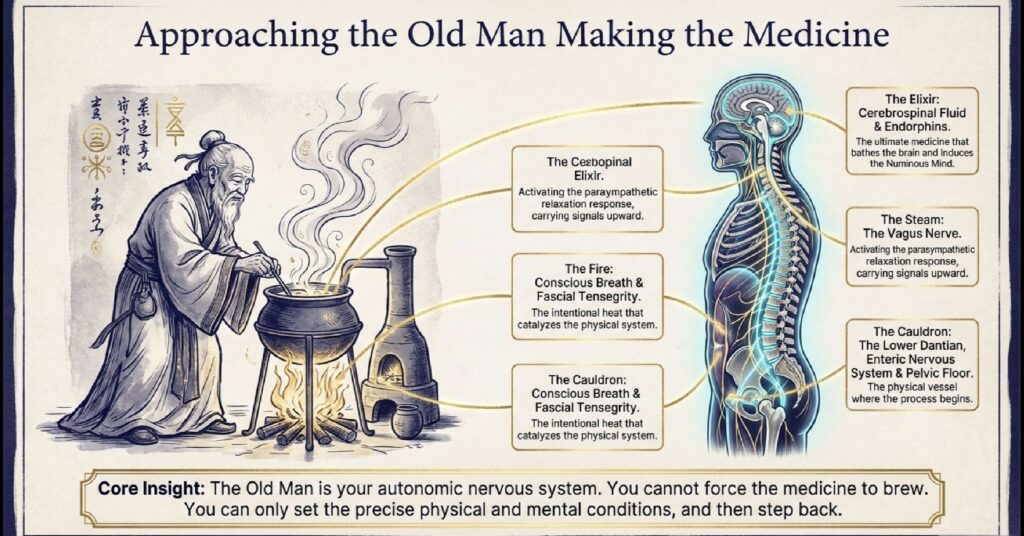
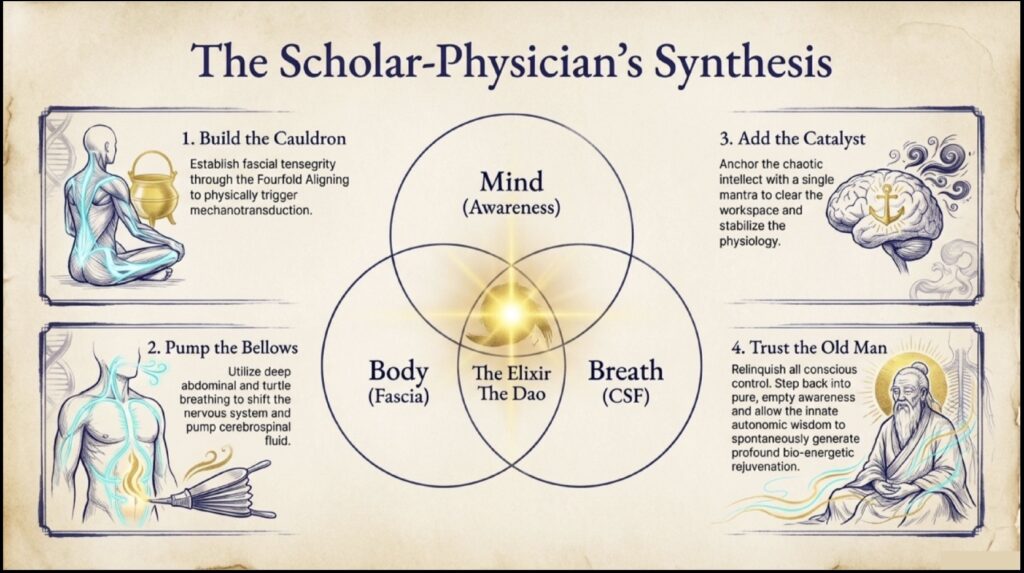
The “Old Man Making Medicine” (or “Heaven, Man, and Earth”) sequence is a clinical application of Neigong designed to restore internal balance and cultivate force.
Part 1: Heaven (The Spine)
- Mechanics: This stage involves the rhythmic bending and straightening of the spine. The practitioner focuses on the articulation of the vertebrae, allowing the spine to ripple naturally.
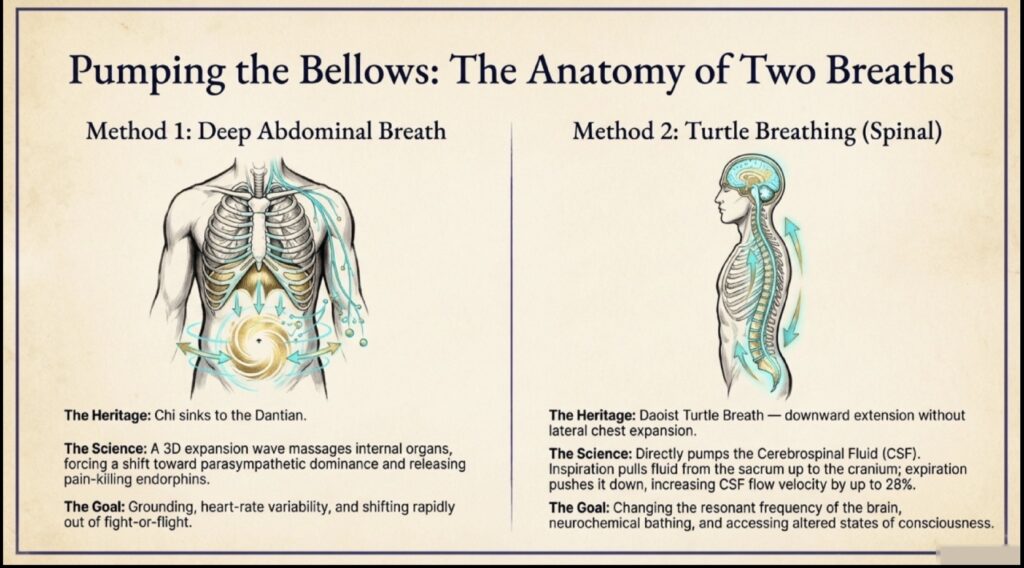
- Internal Application: Traditionally prescribed for the resolution of “internal injuries,” this movement utilizes the spine’s viscoelastic properties to pump fluid through the bone canal systems.
- Breathing: Must remain natural. The movement matches the breath; if the breath is shallow, the movement is small. Never force the synchronization.
Part 2: Man (The Lean)
- Mechanics: In contrast to Part 1, the spine remains “plumb erect” and straight. The practitioner leans the entire torso forward and then returns back to a straight vertical position. There is no bending of the spinal column itself.
- Internal Application: This specific mechanic targets the nervous system, making it an effective intervention for insomnia and sleep disorders.
Part 3: Earth (The Mantra)
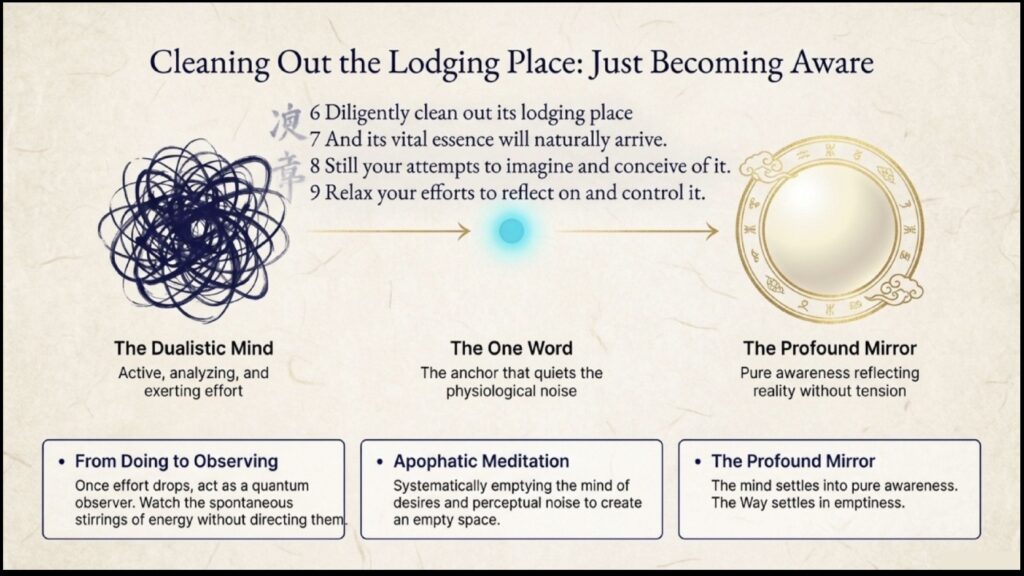
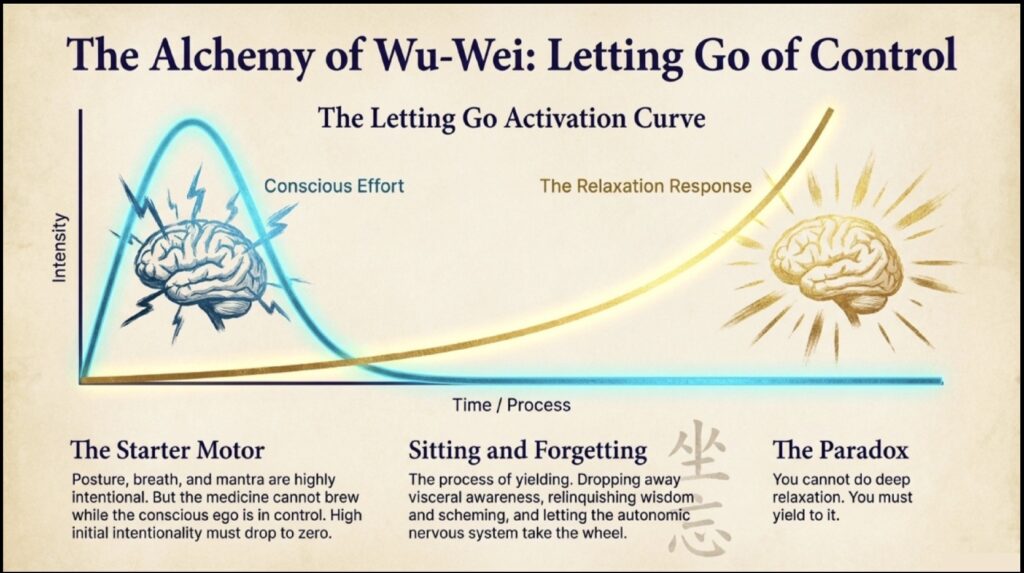
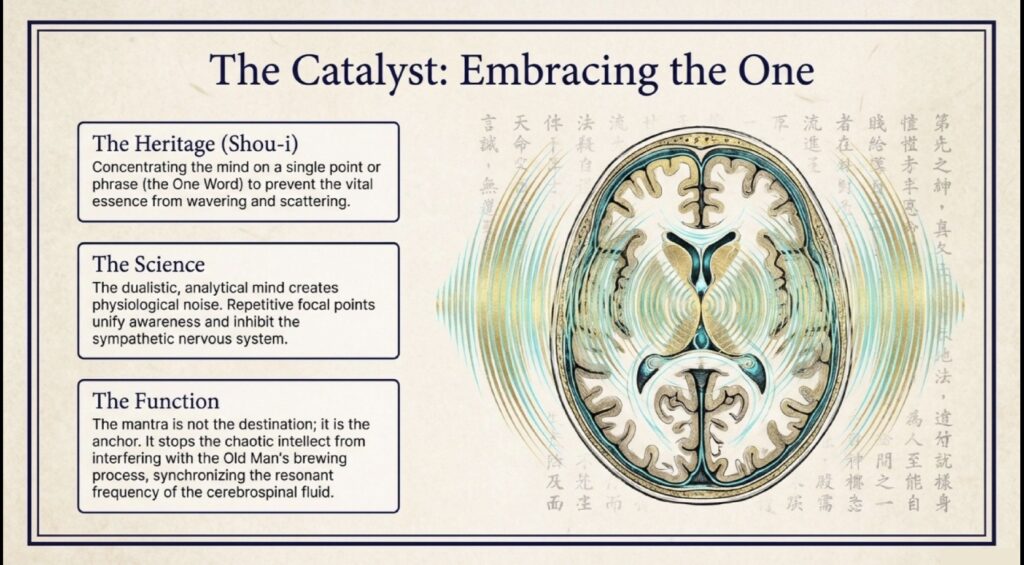
- Mechanics: The physical posture is integrated with a rhythmic, vocalized focal point. The practitioner recites the mantra: Tai Kik Kune, Tai Kik Gung, Chang San Feng Jo Si.
- Instruction: The practitioner must apply the “minimum effective dose” of effort—doing just enough to maintain the shape. This prevents the “Yang Temptation” of over-exertion, allowing the Biofield to stabilize.
Why the “Medicine” Works
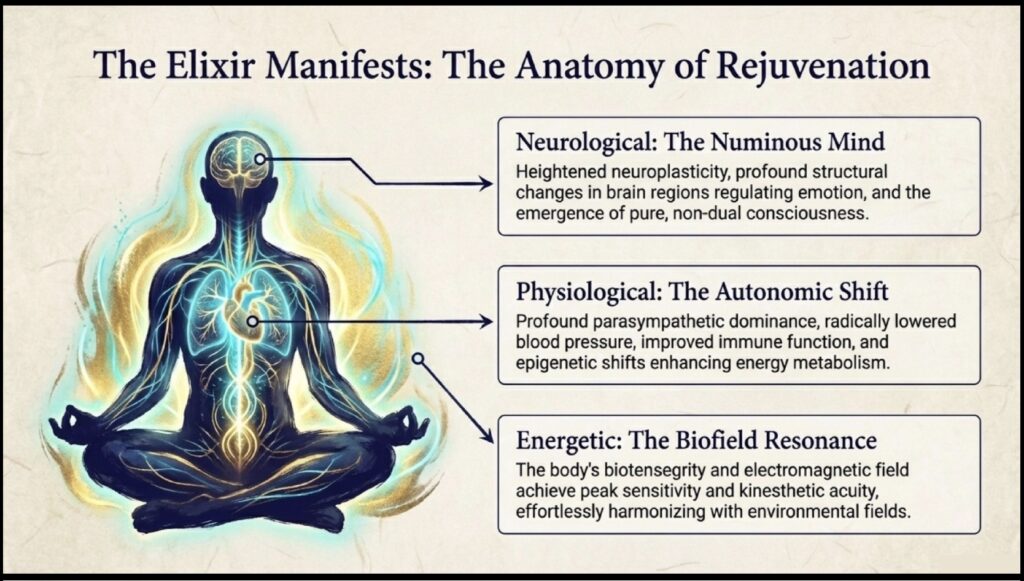
The efficacy of these exercises is found at the intersection of myofascial biomechanics and biofield energetics.
| Mechanism | Scientific Basis | Practical Benefit |
| Myofascial Stretching | Engaging long chains from the feet to the hands. | Stretching the lower limbs increases cervical spine (neck) flexibility via non-local fascial continuity. |
| The Serape Effect | Rotational windup involving the obliques and serratus. | Generates a “rotational windup” that amplifies force production during snapping or striking movements. |
| The Second Heart | Low/medium stances provide isometric loading of the legs. | Acts as a pump for blood and lymph circulation, improving systemic metabolic waste removal. |
| Biofield Energetics | Focused Yi during postures creates Streaming Potentials. | Stimulates bone remodeling and cellular metabolism through fluid flow and electromagnetic signaling. |
| Parasympathetic Shift | Slow nose-breathing triggers the “Relaxation Response.” | Lowers cortisol and shifts the nervous system from “fight or flight” to a state of high-performance calm. |
Mastery Tips for Peak Effectiveness
To transition from a student of movement to a master of energy, one must internalize these senior-level protocols:
- Avoid the “Yang Temptation”: Do not confuse tension with power. In the “Tiger’s Paw” exercise, keep the focus in the palms. Over-tensing the chest or shoulders acts as a “brake” on your energy. Seek “natural tension”—the point where the muscle is active but the fascia is the primary load-bearer.
- Prioritize Shape over Force: In “Planting a Fence,” the effectiveness is derived from the geometric integrity of the posture. The “shape of the fence” provides the power; additional muscular clamping only degrades the “Biotensegrity” of the form.
- The Cat Step Protocol: Every weight shift must be deliberate and controlled. Never “drop” your weight. Use the lowered stances to develop the proprioceptive sensitivity of the ankles and feet.
- Beware the “Tai Chi Dictator”: Practice with intuition rather than rigid counting. While 41, 81, or 111 repetitions are standard, don’t start “hitting yourself over the head with Tai Chi.” If you are injured, do not force low stances. Use Tai Chi; do not let Tai Chi use you.
Conclusion: Remaking the Self through Neigong
Neigong is a stand-alone art of self-empowerment. It is the process of moving from the physical labor of the muscles to the “interpretation of energy” and, ultimately, to spiritual insight.
By mastering the architecture of internal power, the modern person can navigate a high-stress world with the “effortless power” of a balanced body and mind.
This transformation requires consistency and a move away from the frantic. As the old masters suggested, one must have the “patience for the mud to settle” until the water is clear and right action arises by itself. Through the “Old Man Making Medicine,” we do not merely exercise; we forge a body that is vibrant, resilient, and unified.