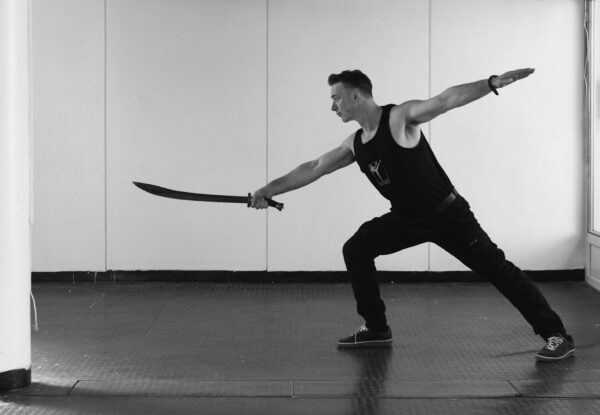
In the rigorous martial curriculum of the Cheng Tin Hung lineage, the transition from empty-hand forms to weaponry marks a practitioner’s evolution from foundational theory to tactical application.
Within our system, the Sabre (Dao) stands as the sixth of the eight core pillars—a curriculum that includes Tai Chi Chuan, Push Hands, San Shou, Dim Mak/Wrestling, Nei Kung, Sabre, Sword, and Spear.
Historically, the Sabre was the “General of all Weapons,” a combat necessity on the battlefield and for civilian defence.
In the modern era, while the Sabre remains a formidable martial tool, it has evolved into a sophisticated discipline for physiological optimization and high-level performance.
This evolution bridges the internal stillness of foundational training with the assertive, dynamic requirements of armed engagement.
Physical Development and Physiological Optimization resulting from sabre work
Training with the Tai Chi Sabre is best viewed as developing physical infrastructure. In this fighting t’ai chi tradition
- Development of Power Mechanics: The Sabre demands that power be generated not from the arms, but through the flexibility and rotation of the waist and spine (腰膂部位轉動靈活). This rotational force acts as the engine, transmitting energy from the core through the limbs and into the blade’s edge.
- Joint and Muscle Elasticity: Consistent practice cultivates a specific elasticity within the muscle groups and opens the joints. Unlike the brittle nature of “Hard Power” (Gāng jìn), the “Soft Power” (Róu jìn) developed here ensures the body remains resilient, absorbing and redirecting force without sustaining structural damage.
- Circulatory and Respiratory Health: The practice facilitates the unobstructed flow of qi and blood. By adopting the natural “turtle breathing” (龜息)—a deep, diaphragmatic method where the lungs extend downward rather than expanding the chest—the practitioner massages the internal organs, resulting in a refreshed spirit and an invigorated constitution.
- Longevity and Anti-Aging: This training is a primary methodology for preventing physical stagnation. By maintaining flexible joints and regulated blood flow, the practitioner resists the hardening and decay associated with aging, promoting a long and vigorous life.
Technical Mastery and Martial Agility
The Tai Chi Sabre possesses a unique movement profile that distinguishes it from the other classical weapons of the system.
While the Tai Chi Sword is characterized by movements like a “flying dragon or a soaring phoenix,” and the Spear is “sticky and continuous,” containing a “hidden reality within the void,” the Sabre is assertive, vigorous, and unrelenting.
- Dynamic Agility: The Sabre form is defined by the tactical movements of “tumbling, shifting, flashing, and spreading” (騰挪閃展). These actions require the practitioner to move with the explosive grace of a predator, constantly changing levels and directions to dominate the environment.
- Agility and Variation: The techniques of our lineage are “agile and highly varied” (靈捷而多變化). The practitioner must adapt to the chaos of combat instantly, utilizing a diverse repertoire of cuts and parries that flow as a single, unbroken intention.
- Internal Energy Integration: True mastery of the Sabre is predicated on Róu jìn (Soft Power). We liken this energy to “deep water” or a “surging tide” that can effortlessly overturn a ship, whereas the “hard power” of other styles is often brittle and easily broken. This deep-water energy allows the practitioner to yield to an opponent’s force before returning it with overwhelming momentum.
This technical agility is not merely a physical feat; it requires a disciplined cognitive state to achieve fluid, reflexive expression.
Cognitive and Psychological Refinement
Beyond physical and tactical prowess, the disciplined practice of the Tai Chi Sabre is a strategic tool for the refinement of the intellect.
The complexity of managing a weighted blade while maintaining internal equilibrium demands total cognitive integration.
- Intellectual Growth and Intelligence: The intricate coordination of the form is inextricably linked to mental vigor. The “wisdom” of our system lies in “using skill to overcome force” (尚術駕力), stimulating the brain through constant spatial and tactical problem-solving.
- Emotional Regulation: Mastery requires a state of “calmness and stillness” (慎靜). This emotional stability is essential for reducing errors under pressure, ensuring that the practitioner remains rational and strategic rather than reactive when facing external threats.
- Mental Clarity: The focused synchronization of mind and body results in “clear-headedness.” By aligning intent with movement, the practitioner develops a sharpened focus that serves as a valuable asset in both the martial arena and daily life.
Aesthetic and Cultural Value of the Form
The Tai Chi Sabre is a profound cultural artifact that balances combat science with aesthetic grandeur. This visual power is vital for preserving the tradition and inspiring the next generation of practitioners. Beauty of external form is also known to be a signal of higher levels of efficiency and effectiveness.
- Grandeur of Practice: When performed with the correct internal alignment, the Sabre form is “extremely spectacular” (極為壯觀). it represents the physical manifestation of Daoist philosophy—power through softness and movement through stillness.
- Auditory Feedback: A hallmark of proper power transmission and speed is the creation of “blade wind” (刀風). When the waist power is correctly delivered to the blade, it produces a sound described as a “whistle or howl” (刀風如嘯), providing immediate sensory confirmation of the practitioner’s skill.
- Artistic Expression: The movements are inherently “comfortable and pleasant” (適意). Masters of our lineage often remark that the enjoyment and physical well-being derived from a correct performance provide a level of satisfaction that is “not purchasable with money.”
In summary, the Tai Chi Sabre is a complete system for the cultivation of the self. It integrates combat-proven pragmatism with high-level physiological health and cognitive refinement, standing as a definitive pillar of the Wudang Tai Chi tradition.