
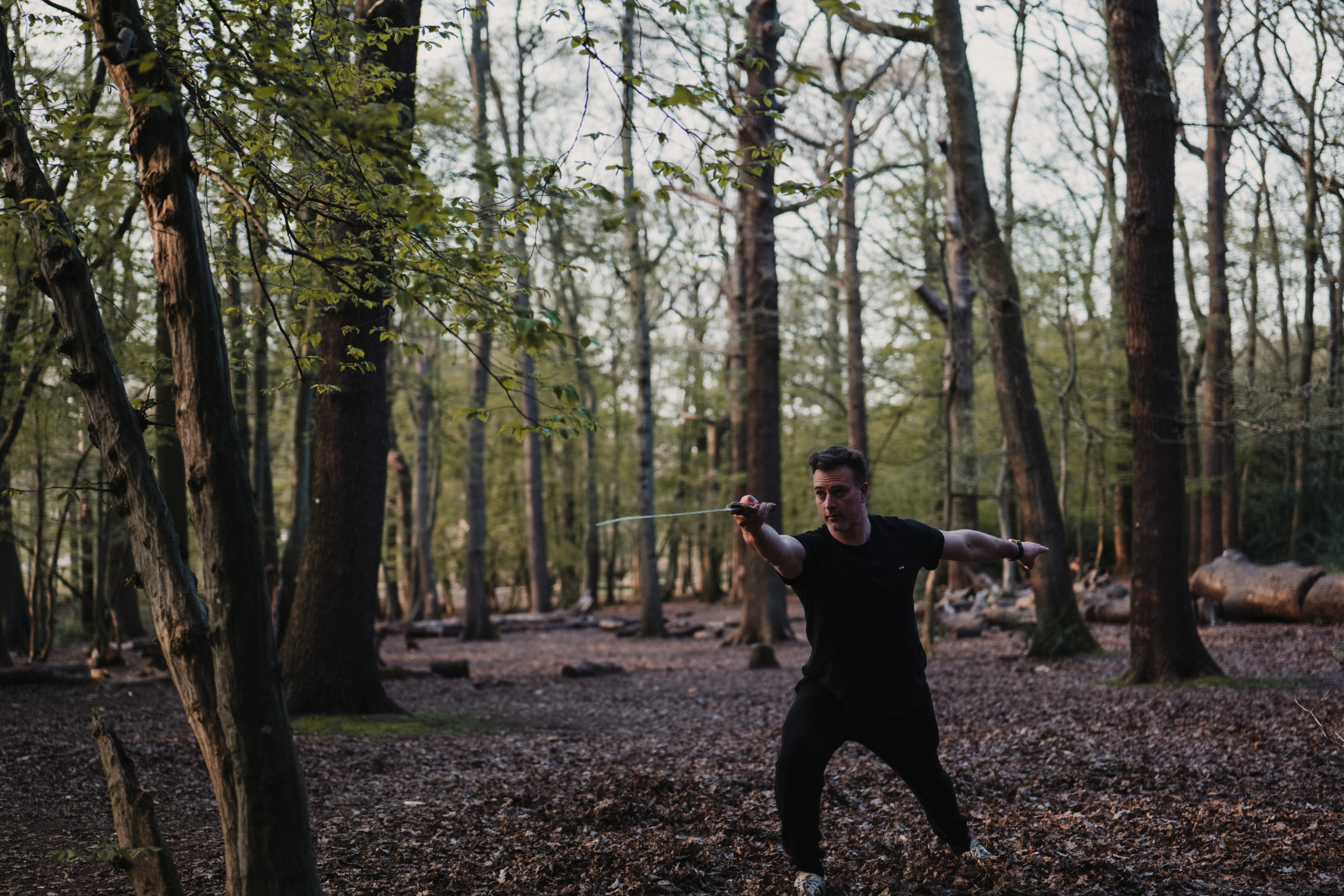
Advanced Awareness / The Sword
In the Cheng Tin Hung tradition, the Tai Chi Sword was never just a battlefield relic or performance prop. It’s a physical expression of the same principle that runs through everything in this system: rigidity breaks, softness survives. Practising the sword is where that idea stops being philosophy and becomes something your body actually learns.
Two ideas sit underneath everything here. First — soft overcomes hard, not through force, but through resilience. Second — Yin and Yang assist each other rather than compete. We’re not looking for one to dominate the other. The best movement is fluid and powerful at the same time, not one or the other.
What it builds physically
The relaxation we train (Song) isn’t looseness for its own sake — it’s deliberate release of tension so blood and energy actually move freely instead of getting trapped in rigid limbs. Combined with the same deep, diaphragm-led breathing used across the whole system, sword practice supports real digestion, real lung capacity, and a body that stays capable well into later life rather than declining with age the way rigid, high-tension training tends to. Elastic strength, built this way, doesn’t exhaust you the way raw muscular effort does.
What it does for your mind
Impulsive reaction is a failure of the mind, not just the body — and training softness is really training judgement. Staying calm under pressure preserves your ability to think clearly, cuts down on the kind of mistakes that come from fear or aggression clouding your decisions, and builds the same steady, unprovoked temperament that’s useful far beyond training. Working through the sword’s technical demands — leverage, timing, precision — sharpens your thinking generally, not just your swordwork.
Why it’s technically demanding
The sword extends your reach, which means any instability in your core or stiffness in your joints gets magnified immediately — there’s nowhere to hide a weak structure. Power still comes from the waist and spine, never the arm; the blade is just where that power arrives, not where it originates. Done well, it moves like something soaring — genuinely graceful, and that grace isn’t decoration. It’s the visible sign that your coordination and internal power are actually working together.
How it works as a weapon
We don’t clash with force — we adhere and follow, deflecting rather than blocking, letting an opponent’s own momentum work against them. This isn’t untested: Cheng Tin Hung proved it himself in 1957, beating Taiwan’s champion, and his students backed it up again at the 1971 Southeast Asian Championships. Circular movement plays a real role here too — an arc, powered by waist rotation, actually closes distance faster than a straight line would. And there’s one thing to genuinely avoid: going rigid, meeting force with force. That’s the one mistake that gets a practitioner controlled rather than in control.
To train the sword properly is to train the whole system at once — form, structure, timing, and mind, all at the same time.
Closing CTA:
Ready to start? [Tai Chi Sword Training Course →] — £111


